
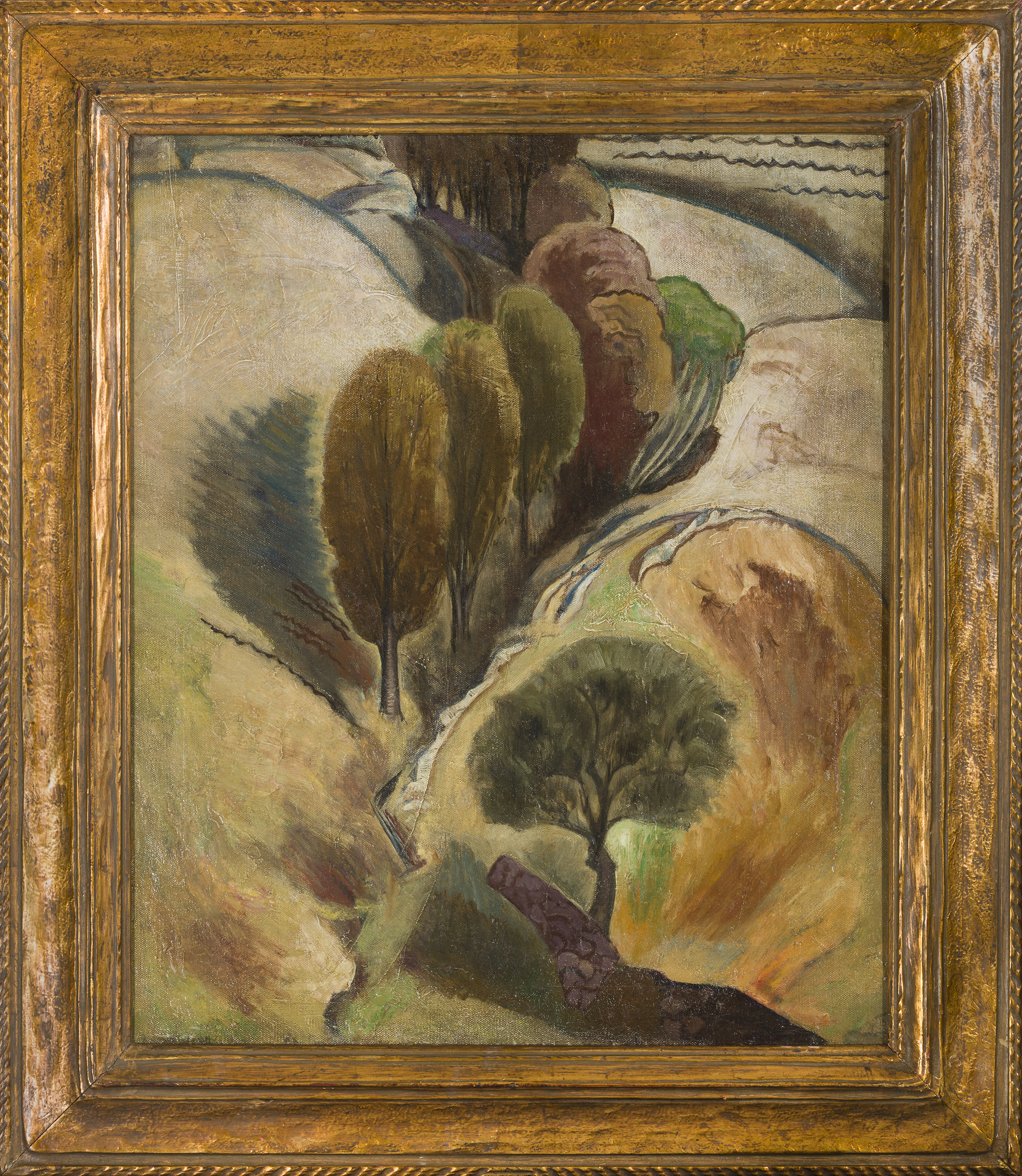
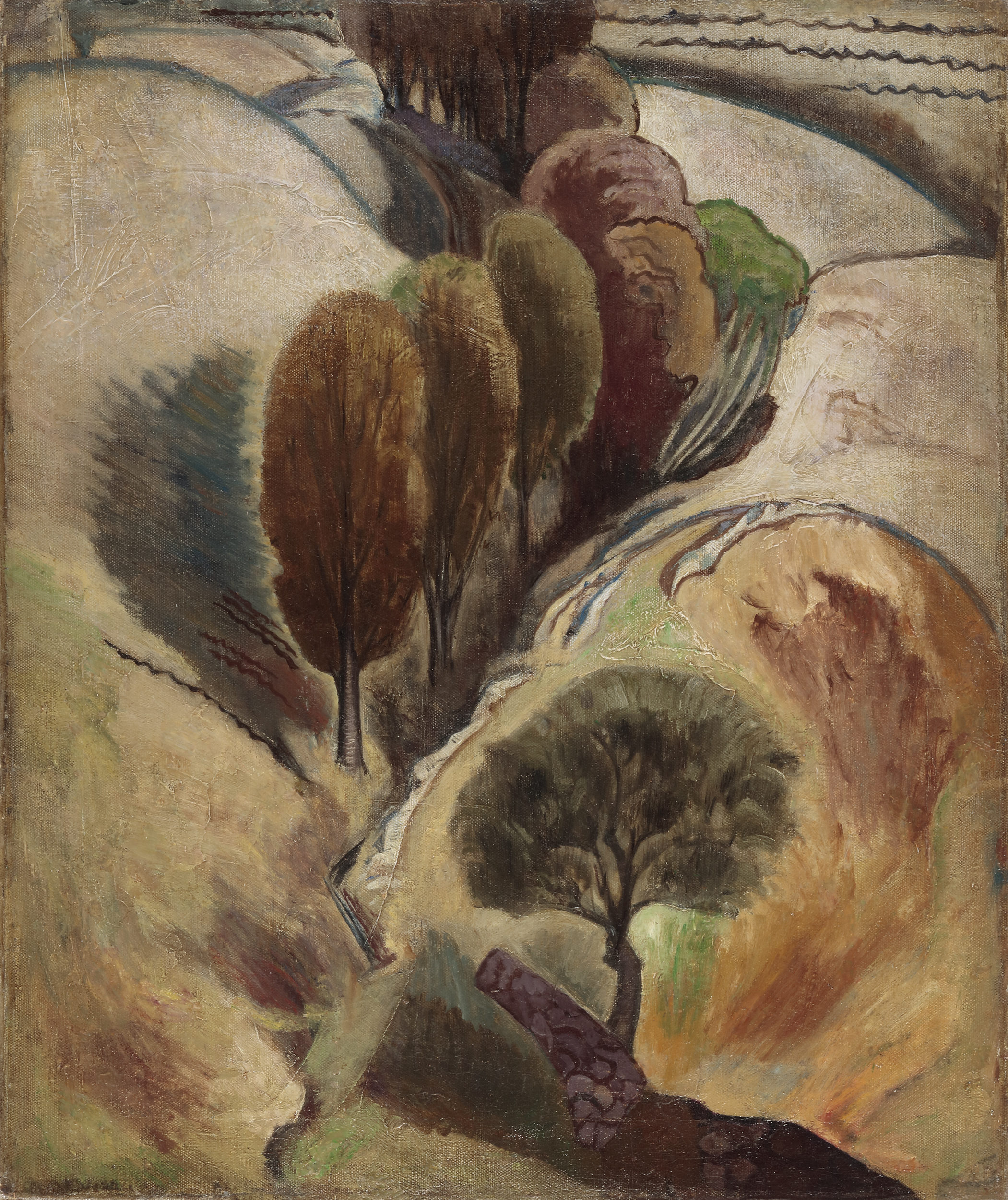
- Iowa (1935)
- 24 x 20 inches
- Oil on Canvas
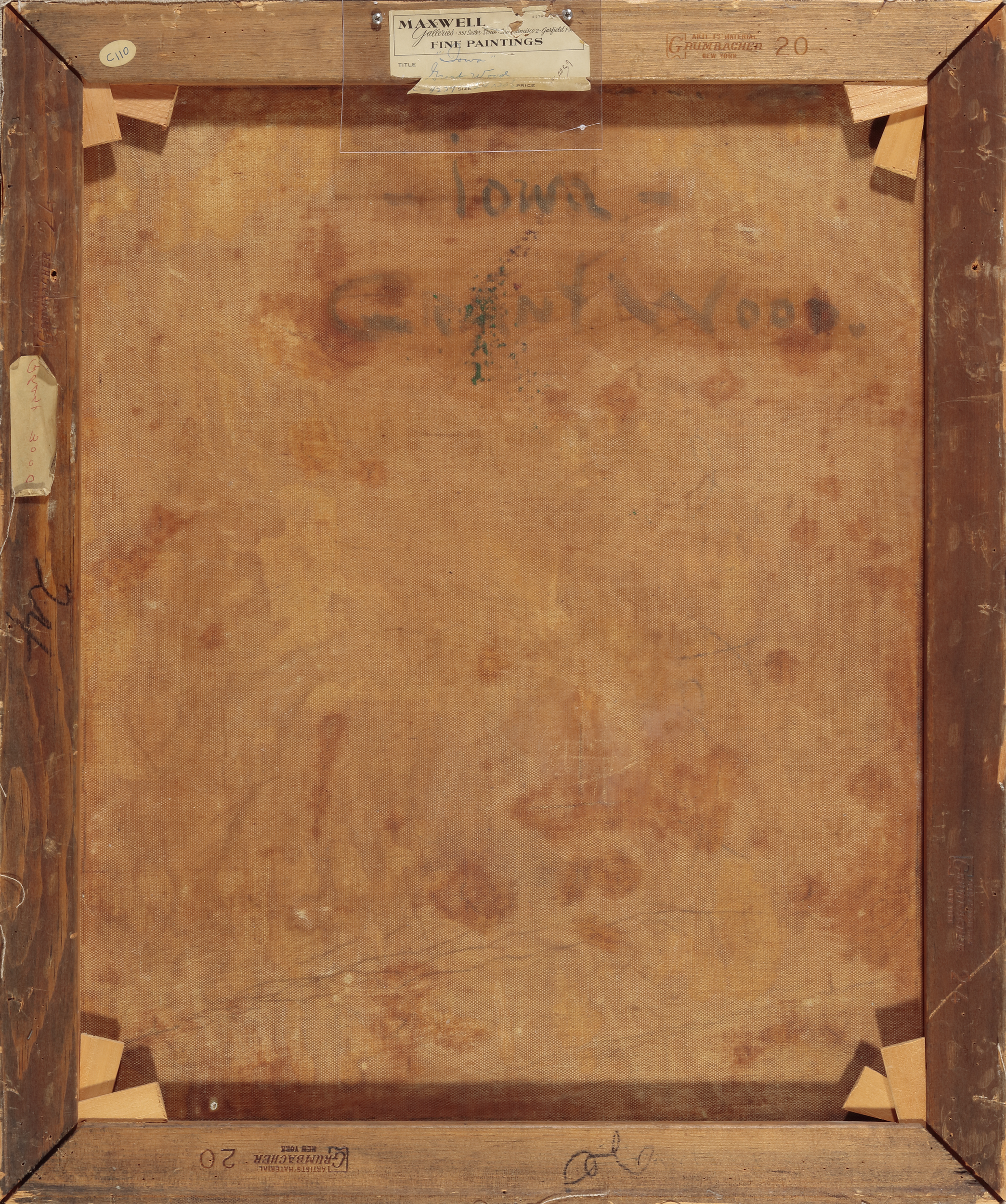
- Signed lower left and en verso, includes label from Maxwell Galleries, LTD, San Francisco.
- Provenance: Private Collection, San Francisco
- Maxwell Galleries LTD, San Francisco
- Grant Wood’s Iowa (1935) was featured in the 1968 exhibition “American Art Since 1850,” which was organized by Dr. F. M. Hinkhouse for Maxwell Galleries, LTD in San Francisco. Hinkhouse was an art historian, curator, and arts administrator with ties to Iowa, having graduated from Coe College in 1947. He later donated his own collection of art to the school in 1967. While working with Maxwell Galleries, Hinkhouse was in touch with Wood’s sister Nan Wood Graham regarding the artist’s work. Written exchanges between the two are in the collection of the Figge Art Museum in Davenport, Iowa, which houses the Grant Wood Archive Collection.
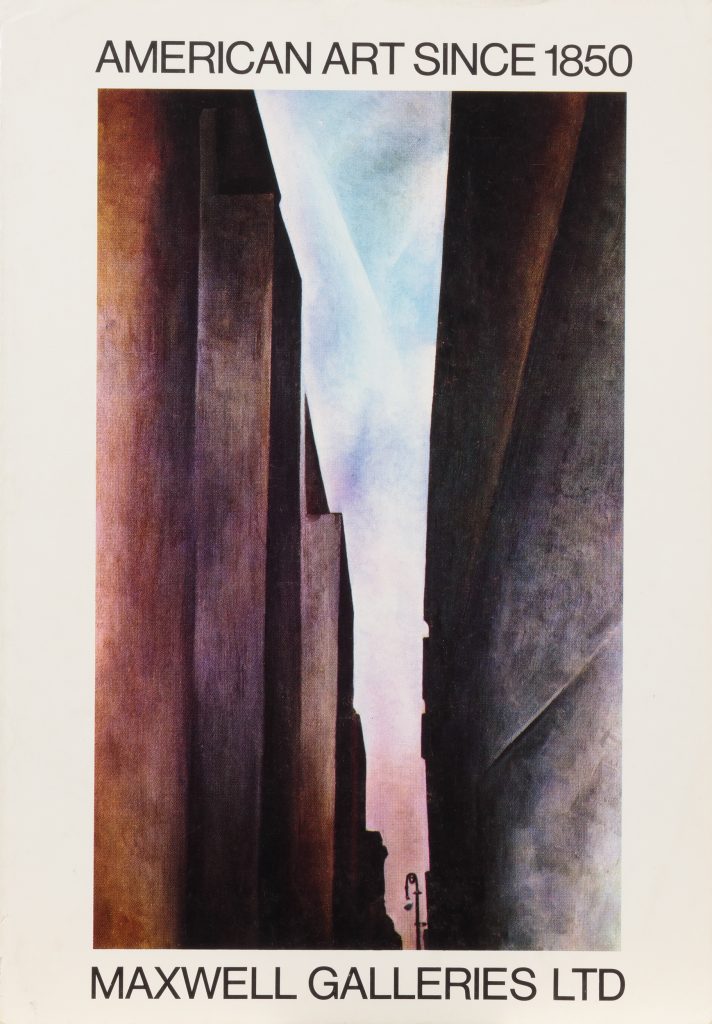
Cover of the catalog to the 1968 exhibition, (Maxwell Galleries LTD, San Francisco)
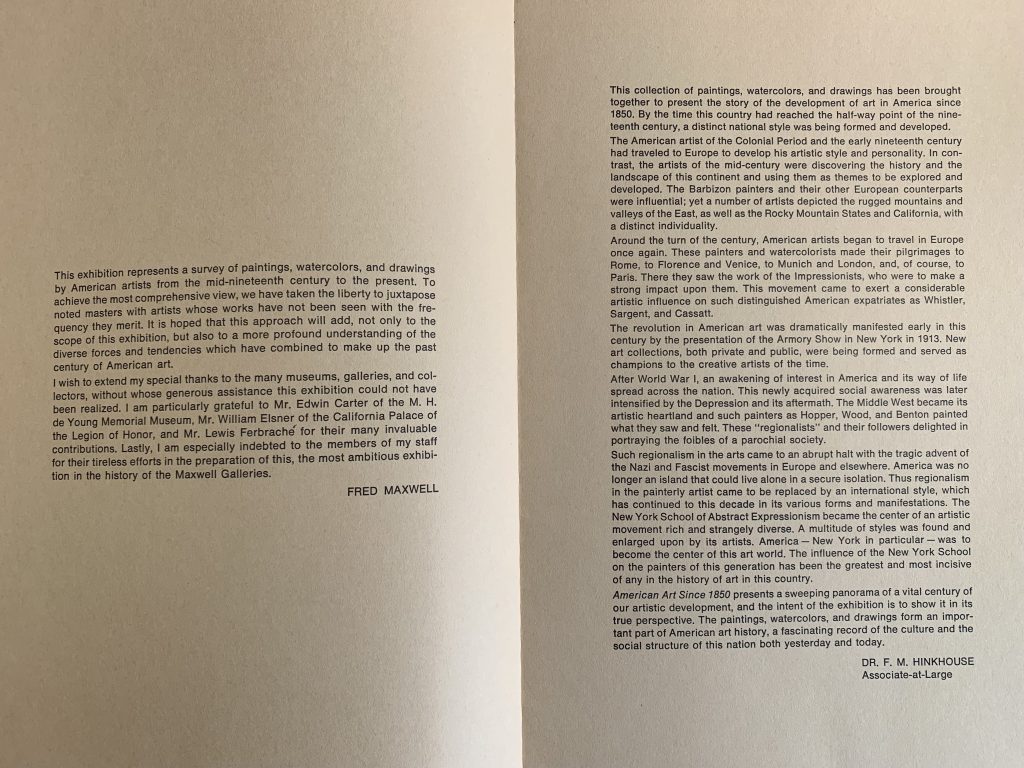
Introduction to the exhibition “American Art Since” 1850 by Dr. F.M. Hinkhouse, Maxwell Galleries LTD Associate at Large.
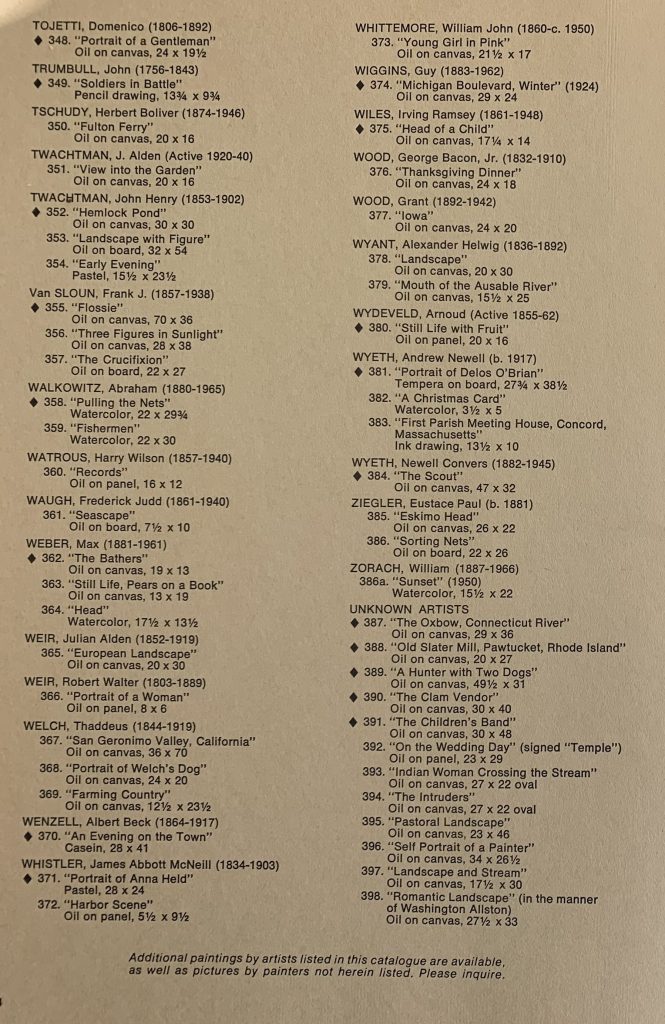
Exhibition checklist with Grant Wood’s Iowa listed with inventory #377 in “American Art Since 1850,” pg. 84.
San Francisco’s Maxwell Galleries: A Local Gallery with National Ambitions
By Maymanah Farhat
When the San Francisco Museum of Art opened in 1935, its founding director, Grace McCann Morley, envisioned an international center for art. The museum would later be renamed the San Francisco Museum of Modern Art (SFMoMA), a more fitting moniker given its influential, forward-thinking program, which placed equal emphasis on art history and emerging art movements while striving to make institutions more accessible to the public. Under Morley’s leadership, the museum organized historic exhibitions of European modernists, including Paul Cezanne, Pablo Picasso, and Henri Matisse, while also championing post-war painters such as Jackson Pollock and Clyfford Still. In 1945, for example, Morley gave Pollock his first museum solo exhibition; and created a sales program for local artists the following year, the first of its kind in the United States. As she worked closely with New York galleries and museums, securing loans and traveling exhibitions, San Francisco quickly became the West Coast capital of American art.
Frederick “Fred” Maxwell opened his eponymous gallery in 1940 amid the lively cultural atmosphere that the San Francisco Museum of Art created. In many ways Maxwell Galleries developed a similar program despite operating as a commercial art space. Like Morley, Fred Maxwell sought to expand California’s collecting base, and often went to great lengths to secure new clients during his initial years as a gallerist. One unorthodox approach, for example, was an annual trip to the state’s Central Valley, where he set up pop-up galleries in roadside motels near major highways. Advertising his sojourn in regional newspapers beforehand, he would arrive with a station-wagon full of paintings, hoping to attract some of the area’s wealthy farmers. His efforts were extraordinary for the time given that local artists lacked institutional backing and patronage in a place where a culture of collecting was virtually nonexistent. In the early 1940s, there was but one art museum in the region, the Haggin Museum in the northernmost city of Stockton, which housed a small but significant collection of nineteenth-century paintings assembled in San Francisco and Paris.
Maxwell Galleries opened at 372 Sutter Street, a few blocks north of San Francisco’s Union Square, a bustling plaza and the site of the first underground parking garage in the country. Although this central location proved to be successful, the gallery eventually moved to a larger space a couple of blocks down the street. There, Fred Maxwell mounted exhibitions and showcased his inventory in several spacious rooms, including a lower level gallery, which amounted to seven thousand square feet of wall space. Known for organizing museum-quality shows, he quickly became one of California’s leading gallerists.
The range of art highlighted in Maxwell Galleries not only reflected Fred Maxwell’s personal taste but also the city’s commercial art scene, which was swayed by the Bay Area’s art collecting elite, who mostly preferred historical mainstays like the Barbizon, Hudson, and Rocky Mountain schools of painting. Yet Maxwell also
featured artists who were relatively unknown or under appreciated. He was one of the few mid-century gallerists to promote the works of early California painters who were not properly documented until the 1990s. San Francisco Bay Area painters figured into the annual exhibition lineup as well, including David Park, who was highlighted in a number of solo and group shows after Maxwell Galleries took over his estate in the 1970s. In David Park: A Painter’s Life, Nancy Boas describes how the gallery was successful in placing his post-war work in collections across the country despite the waning influence of Bay Area figurative painters amid the advent of more experimental media such as video art and installation (2012).
Fred Maxwell’s ambitions as a gallerist were perhaps most evident in the sweeping exhibition American Art Since 1850, which he presented throughout the month of August in 1968. With the assistance of art historian Dr. F.M. Hinkhouse, the exhibition featured over a century of painting, watercolor, and drawing with nearly four hundred works selected from the gallery’s inventory and on loan from private and public collections. Hinkhouse served as the founding director of the Phoenix Art Museum before joining Maxwell Galleries as an “associate at large,” and was a collector in his own right, having donated a small modern art cache to Coe College in Cedar Rapids, Iowa. While Hinkhouse’s expert knowledge and robust Rolodex undoubtedly helped secure loans, by the 1960s Maxwell Galleries had branched out to include museum-grade conservation and reputable appraisal services, giving its founder unrivaled access to the forgotten gems that were tucked away in Northern California homes.
In the forward to the exhibition’s catalog, Fred Maxwell describes the diversity of the selected works as part of the gallery’s effort to present a comprehensive assessment of American art, stressing the conscious pairing of canonical artists with obscure or overlooked figures (1968). To this effect, viewers could find an exemplary 1920s scene of Manhattan by Georgia O’Keeffe in the same space as Charles Christian Nahl’s Little Miss San Francisco (1853), a Gold Rush era portrait of a child, or Yasuo Kuniyoshi’s mixed-media drawing of a Colorado mining town in the 1940s. Other exhibition highlights, including John Singer Sargent’s luminous Study of Architecture, Florence (1907) and Female Model (1869) by Thomas Eakins, were on loan from museums, in this instance San Francisco’s de Young and Legion of Honor, respectively. These works, among several others, emphasized how American artists often adapted the stylistic elements of academic painters when working in Europe, a historical development that Hinkhouse notes in the catalog’s introduction. Illustrating this point, Eakins’ portrait, which he painted while studying with Jean- Léon Gérôme at the École des Beaux-Arts in Paris, contains traces of French Orientalism.
Additional examples of American artists abroad included a pastel drawing by Mary Cassatt listed as “Mother and Her Baby,” an atmospheric painting of the Grand Canal in Venice by Thomas Moran, and a large double portrait of Childe Hassam’s wife and her sister, which he produced in Paris in 1893. Several artists like Moran and Hassam in addition to William Merritt Chase, George Bellows, and Marsden Hartley
were represented with multiple works in the exhibition. Moran’s An Indian Pueblo, Laguna New Mexico (1908), for example, demonstrated the range of his landscapes while expanding the exhibition’s significant selection of art depicting the Southwest. John Sloan’s 1926 painting Hill in the Canyon depicting adobe houses and a New Mexico mountain range shaded by low-lying clouds complemented Moran’s intimate view of a Native American settlement, as the former seems to describe the majestic landscape that is seen in the distance of the latter. Maynard Dixon’s scene of a barren Nevada valley, where wild horses run free from the constraints of domestication, further described the idyllic desert landscapes that took hold of the American imagination in the first part of the twentieth century.
Although American Art Since 1850 primarily comprised landscapes, portraits, and genre scenes, with only a handful of abstract compositions and still lifes, the exhibition’s eclectic roster of artists reflected the variety of approaches and styles that shaped figurative painting throughout the United States. Arthur B. Davies’ turn- of-the-century allegorical scene stood in contrast to a whimsical snapshot of Coney Island by Reginald Marsh, which illustrated the brand of social realism that developed among Depression era New York painters, whereas Joseph Adam Imhof’s meticulously detailed portrait of Geronimo was indicative of the Southwest excursions that were popular among early twentieth-century artists.
The stoicism captured in Imhof’s painting is reminiscent of the stereotypical imagery of Native Americans made popular by late nineteenth-century photographer and ethnologist Edward Curtis. This approach appears in many of the paintings and drawings that Imhof created while in New Mexico, which is not surprising given its wide acceptance across media, especially in American films.
Maxwell Gallery offset this imagery by including Robert Henri’s striking portrait An Indian Girl in Rose. The pensive Santa Clara Pueblo woman is portrayed with the same sensitivity and humanity that characterizes Henri’s other portraits. The Autry Museum of the Southwest in Los Angeles, where it was recently on loan, identifies its subject as Gregorita, one of two young Native American women who posed for him multiple times over the course of three summers, beginning in 1916. Overall, Henri produced more than two hundred paintings during his short stays in Taos and Santa Fe.
Landscape painting was presented in abundance. Modernist samples like Edward Hopper’s 1940 emptied Cape Cod scene (borrowed from the Oliver James Collection at Arizona State University) provided a fascinating comparison to Rembrandt Peale’s copy of a monumental Salvator Rosa panorama, demonstrating how American painters gradually shifted their focus from classical prototypes to probing everyday life and their surroundings. For Hopper, this meant identifying “the sad desolation” of the American urban landscape. A counterpoint to Hopper’s brooding depiction of a New England Victorian home was Grant Wood’s vertical rendering of the rolling hills of eastern Iowa with a slim, tree-lined creek that meanders between two gentle slopes and a stonewall that cuts through the foreground. Iowa contains all the quintessential elements of Wood’s 1930s bucolic scenes.
Maxwell Galleries near eschewal of abstraction in American Art Since 1850 was uncharacteristic for the period given that Abstract Expressionism had been widely embraced in the Bay Area a decade before after a notable circle emerged from the San Francisco Art Institute under Clyfford Still, spilling into artist-run galleries in the adjacent North Beach district as painters and sculptors regularly fraternized with members of the Beat Generation. The 1960s were especially dynamic as local artists were well versed in assemblage, collage, and automatic forms of painting inspired in part by Surrealism, Jungian psychology, and Eastern philosophy, not to mention the various countercultures that sprung from the city. Maxwell Galleries’ selection was most likely motivated by the figurative leanings of their clientele. At the same time, it could also be that because these specific art movements were relatively new and regionally centered, they were not considered in the gallery’s overview of American art history, despite the fact that institutions like SFMoMA and the Stanford University Museum had exhibited central figures such as painter Fred Martin and multimedia artist Wally Hedrick a few years before.
Maxwell and Hinkhouse could not completely ignore the importance of abstraction, however, and included two small oil paintings by Robert Motherwell, in addition to Raimonds Staprans’ Ledge of Land, which although recorded in the show’s catalog without a date is rendered with the earth tones that are found in a 1960s series by the painter. Staprans—who studied under Mark Tobey in Seattle, and later with Hans Hoffmann at the University of California, Berkeley—exhibited with Maxwell Galleries from 1955 until the late 1990s. Staprans was one of several Bay Area artists who Maxwell sponsored in the early part of their careers, providing vital support. Another was seminal sculptor Louis Pearson. The recent traveling survey Full Spectrum: Paintings by Raimonds Staprans, which debuted at the Crocker Museum in Sacramento, California, contained a number of examples that were created while he was affiliated with the gallery.
A curious curatorial thread of American Art Since 1850, which might have resulted from the difficulty of securing certain works, was the inclusion of modernist figures like Stuart Davis and Jackson Pollock with examples that predate the groundbreaking painting styles that cemented their importance. Without the gallery’s notation, viewers would have struggled to identify Davis’ Land and Sea (1914), a loosely painted work that reflects the influence of the Ashcan school, or his unfinished 1917 realist drawing of a small town. Unknown to most, this period of Davis’ work was not given serious consideration until 1990, when New York’s Salander-O’Reilly Galleries, which represented his estate, mounted Stuart Davis: Scapes, an exhibition that explored his artistic origins as a plein air painter and a student of Robert Henri.
Similarly, Pollock’s punchy late 1930s cruxifiction scene—one of the few works reproduced in color in the exhibition’s catalog—more closely resembles the late expressionist style of Mexican muralist Jose Clemente Orozco, whose frescos he greatly admired. This small gouache painting is simply titled “Composition” in the
gallery’s list of works, which Maxwell and Hinkhouse most likely ascribed. The work on paper was borrowed from Dr. Joseph Henderson, a San Francisco psychiatrist who treated Pollock over the course of eighteen months beginning in 1939, shortly after the artist’s nervous breakdown.
Henderson had dozens of works on paper by Pollock in his files, having received them directly from the artist when he underwent psychoanalysis at the doctor’s New York office and was unable to effectively communicate during their one-on-one sessions. Henderson maintained that the drawings formed a window into Pollock’s thinking and emotional state during treatment, and were guided by his Jungian techniques; in actuality their imagery was derived from a variety of sources and were part of the larger experiments that characterize his 1930s work. In 1969, the psychiatrist sold the collection to Fred Maxwell, who presented it in its entirety a year later with a publication authored by the gallery’s in-house curator C.L. Wysuph. Maxwell Galleries then organized a touring exhibition at high-profile venues, including the Whitney Museum of American Art. Expectedly, given the sensitive nature of the collection’s provenance, intellectual debates ensued.
Writing in Art Forum in 1971, Rosalind Krauss reports that Henderson sold the works with Lee Krasner’s consent but was unaware of Maxwell’s plans and had no knowledge of the exhibition or its accompanying catalog. Yet one of the colored pencil drawings reproduced in the gallery publication credits the collection of Dr. Henderson, suggesting that he lent the work. A 1985 article in the Christian Science Monitor offers another conflicting narrative, citing Krasner’s disapproval of the sale, which she described as “a violation of privacy” to a medical magazine around the time the transfer of the set was announced.
Krauss concludes her 1971 review by arguing that bringing the drawings to light will benefit art historians regardless of Wysuph’s shaky introduction, which provides overly simplistic interpretations based on Henderson’s findings and can be sensationalist at times. The drawings have since entered private and public collections such as the Metropolitan Museum of Art and the Hood Museum of Art at Dartmouth College. In 2012, the Hood Museum organized a groundbreaking exhibition examining Orozco’s enduring influence on Pollock, and featured several of the “psychoanalytic” drawings. Aside from the controversy that the sale of the collection generated, what this historical anecdote demonstrates is that Fred Maxwell had the foresight to showcase the works knowing that the gallery could redirect scholarship to an important yet neglected stage of Pollock’s development.
Tracing the afterlives of the paintings and drawings of American Art Since 1850 similarly reveals the extent to which Maxwell Galleries operated with a broad view of art history and often laid the groundwork for future research.
Copyright Jost Fine Art, 2018
OTHER ARTWORK FROM THIS ARTIST
