
FOR IMMEDIATE RELEASE:
Jost Fine Art is pleased to announce Mary DeNeale Morgan’s Central Coast, the inaugural exhibition of the gallery’s new Central California location. The exhibition has been organized to coincide with the Monterey Museum of Art’s retrospective of the artist’s work, Mary DeNeale: Doyenne of the Carmel Art Colony, and will be on view from July 15 to September 23, 2026.
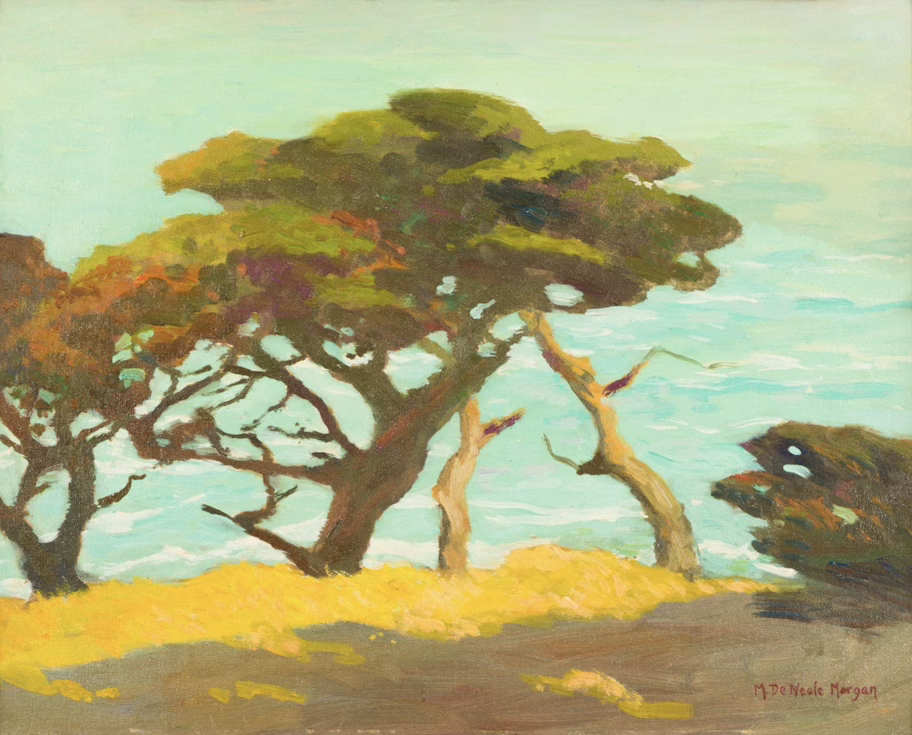
Featuring nearly two dozen works, Mary DeNeale Morgan’s Central Coast highlights the artist’s distinct approach to depicting the golden hills of Carmel Valley and the rugged, tree-lined cliffs of Monterey Bay. For over fifty years, Morgan (1868–1948) was a leading woman artist in the U.S. and a fixture of the Carmel art colony, an early twentieth-century hub for art in Northern California. While living and working in Carmel-by-the-Sea between 1903 and her death in 1948, her work evolved from soft Tonalist landscapes to vigorously painted colorist scenes that describe the dynamism of the region’s natural palette. Her paintings of Monterey Cypresses, for example, capture the elegance of the majestic trees, their gnarled trunks emerging from the rocky terrain of sea cliffs like outgrowths of the earth. Inland, Morgan turned her attention to the Coastal Live Oaks and Valley Oaks lining the foothills, which were home to rural agricultural communities at the time. The canopies of these ancient trees dominate her compositions as they blanket the Central Coast savannas in shade.
A standout painting in the exhibition is the artist’s Last Painting (Point Lobos) (1948). Bearing an inscription that reads “last painting” on the back of the canvas, the work foregrounds Morgan’s late style as she turns her attention to a cluster of Monterey Cypress trees. Situated at the edge of a cliff, the trees form a screen through which the blue-green hues of choppy waves are filtered. A shadow is cast on the path leading to the cliff’s edge, causing it to radiate with the intensity of the midday sun. Bordering on abstraction, the painting is executed with loose, broad brushstrokes and radiating color, reflecting the plein-air artist’s ever-greater devotion to her subject matter.
About the Gallery
For over a decade, Jost Fine Art has offered museum-quality works as an online gallery focusing on North American art from the late 1800s to the present. The opening of a brick-and-mortar space in July 2026 marks a new chapter for the gallery, as it becomes one of the few places to experience this breadth of art in California’s Central Valley. Curated exhibitions presented online and at its Downtown Kingsburg location represent some of the most influential art movements of the nineteenth and twentieth centuries while also highlighting contemporary artists who draw inspiration from these historical legacies.
Jost Fine Art works closely with a variety of clients, from those seeking to build private collections to American museums that are in the process of expanding their holdings, particularly as the canon of art history continues to be revised. Its curated selection of available works has been assembled through a research-driven approach that centers documentation and scholarship, with the aim of nurturing connoisseurship by identifying and filling existing gaps in information.
About the Artist
Mary DeNeale Morgan was born in San Francisco in 1868 but spent most of her artistic career living and working on California’s Central Coast. Morgan was an early proponent of plein-air painting in California and a leading figure in Carmel-by-the-Sea’s artistic community during the first half of the twentieth century.
Morgan received her artistic training at the California School of Design in San Francisco between 1886 and 1892 under the mentorship of several notable artists, including painter Arthur Mathews. She later worked with Scottish-American painter William Keith, who was a neighbor and family friend in Oakland, where she was raised. Both Mathews and Keith influenced her initial style of painting, which was distinguished by a Tonalist approach primarily executed in tempera.
Although working in the Bay Area, Morgan frequently visited California’s Central Coast, beginning with a painting trip to the northern agricultural region of Monterey Bay in 1902. She later settled in Carmel-by-the-Sea in 1910 and studied there with the American Impressionist William Merritt Chase during his summer teaching residency in 1914.
Over time, her painting style shifted from ethereal Tonalist landscapes to vibrant, impasto, palette-knife-painted scenes of the coast and the inland areas she called home. She took a particular liking to the Monterey coastline, painting its majestic cypress trees and rocky cliffs, and eventually became part of a local conservationist movement that sought to preserve Carmel-by-the-Sea’s public access and beaches.
She was a co-founder of the Carmel Art Association and a prominent member of the early twentieth-century Carmel Art Colony. In 1924, Scribner’s Magazine identified her as one of the foremost women artists in the United States. Morgan died in 1948 at the age of 80.
Morgan’s works are held in collections across the United States, including the Crocker Art Museum, Monterey Museum of Art, Los Angeles County Museum of Art, and Oakland Museum of California, among others.
Download the press release (PDF)